Lo Que Existe En El ‘Silencio’: Notable Representations Of Mexicanidad Across David Lynch’s Work
While I have been preparing and researching for this essay, Los Angeles has been thrown into upheaval over the presence of ICE and the National Guard in what is supposed to be a sanctuary city. Entire streets with businesses are shuttered as undocumented immigrants are afraid to open up their stores. The sheer number of people who have come to protest and the response by those who are impacted by the loss of Latine and undocumented communities in LA, is a direct reflection of the Latine impact on Los Angeles. Los Angeles wouldn’t be the city it is today without the over 1 million Mexican Americans that live in LA county. It is impossible to discuss the Mexican Americans of LA in scholarship without talking about the very real ramifications we are seeing today while the U.S government tries to erase them from our community. While I grew up in Austin, the impact of the Mexican American community has been impossible to remove from my life as well, and continued through my time at UCLA. I speak better Spanish than my native tongue, Thai, because of the Mexicans I consider family that I grew up with and around my entire life. For me, it is impossible to imagine a Los Angeles, an America without the Mexican American community.
While to the best of my knowledge, David Lynch never directly spoke about the Latine or Mexican American community, they have shown up most notably as characters in Wild at Heart and Mulholland Drive. The representations of Mexicans highly contrast each other, as Wild at Heart has been highly criticized for its portrayal of people of color as violent criminals, while Mulholland Drive showcases Rita/Camila as a fully fledged Latina character, the only main character of color in Lynch’s work. While David Lynch has been criticized for his lack of people of color in his films, as well as his tendency to lean on stereotypes for the people of color he does include, Mulholland Drive appears to be a departure from this trend. While the portrayal of Mexican Americans in Wild at Heart are plagued by racist stereotypes of violent criminals, Mulholland Drive explores the relationship between Los Angeles, cinema and Mexican Americans in its Latine characters, demonstrating the impossibility to create a narrative of Los Angeles without including Mexican Americans.
Wild at Heart’s depiction of Perdita and Juana Durango are originally based on Lynch’s reimaginations of what it means to be Mexican. In Room to Dream, Isabella Rosselini recalls how Perdita was based on her and David Lynch’s discovery of Frida Kahlo:
Years before he made Wild at Heart, David and I were in a bookstore and I saw a book on Frida Kahlo. This was before she’d been discovered by pop culture, and I called David over and said, ‘Look at this woman.’ She’s appealing and repellent at the same time. Sometimes she portrays herself with visible wounds; other times she has a mustache and eyebrows that grow together. She had an incredible aesthetic, and I said it would be wonderful to create a character like her. Years later David said, ‘I think I have that character.’ Perdita Durango was based a little bit on Kahlo—the eyebrows are definitely an homage to her (McKenna & Lynch 271).
Within the politics of Mexican pop culture figures, Frida Kahlo has been criticized for commodifying indigenous identity despite having a mestiza background. Kahlo was a part of the Indigenismo ideological wave, trying to reclaim an indigenous identity to promote Mexican nationalism, but she had a German father, a white Latina mother, and a loose connection to Tehuana/indigeneity (Cheran 1-4). Joanna Garcia Cheran, a Purepecha writer, explains how like herself many other indigenous people criticize both Kahlo’s performance of indigeneity and indigenismo as a movement that ignored indigenous voices. With the indigenous perspective in mind, Perdita Durango becomes a reinterpretation of a reinterpretation of Mexican. The Durango sisters become caricatures of indigenous Mexicans. Race, Latinidad becomes reinterpreted by Lynch, creating characters that seem severed sociopolitical lines that the white characters of aren’t.
Futhermore, Grace Zabriskie’s character of Juana was born from Lynch’s interest in Zabriskie’s accent. Juana Durango wasn’t a character in the book, but rather Lynch’s interest in the “Cajun kind of talk” Zabriskie, from New Orleans would use on the set of Twin Peaks (Lynch & McKenna 282). Juana’s identity becomes more confused as she is supposed to be a Cajun (descendant of French/Arcadian settlers) but also Mexican, because she is Perdita’s sister. Sharon Willis describes her as “Overloaded with difference” (Willis 145). In this way the Mexican identity becomes something for Lynch to play with and modify on his own within Wild at Heart, ignoring what it actually means to be Mexican. Both actresses are not Hispanic. Within the Latine community exists Latines of many different races, including white Latines, so arguments of cultural appropriation become blurry. However it seems that because Juana and Perdita are meant to evoke mestizas, because they are evoking Kahlo, meaning they should have some percentage of indigeneity to be accurate. Which they don’t.
The Durango sisters, as well as every other person of color in Wild at Heart, are violent, terrible criminals. Juana’s appearance, “the excessive and ambivalent figure of the phallic woman, the mutilated woman, who is also a figure of ethnic and racial exoticism and difference” (Willis 145) becomes sensationalized through her great acts of violence. Juana’s ethnic otherness becomes connected, perhaps correlated to her violence. Juana “is recognizable as the lusus naturae of David Lynch's worst nightmare. She becomes ours as well: screaming full into the camera -at us-she represents as directly as anything in film history one artist's imagined face of death” (McKinney 43). The blurring of murder and erotics in the killing of Harry Dean Stanton’s character also presents a very weird image when conducted by a Latina and Black character. What are the moral repercussions of portraying death as murderous Latina? The ambiguity/nonsensical aspect of Juana’s racial identity makes it seem like it is an afterthought, only further aggravated by her position as a character central to violence.
At the very least, Rita/Camila Rhodes is played by an actual Mexican actress. Laura Elena Harring was cast as Rita after a single meeting (McKenna & Lynch 351). A Mexican American actress from Sinaloa, she was cast because she immediately got along with Lynch, a pattern with many of his actors. Within the character exists an interesting metaphor of Rita Hayworth’s life for Latines. Rita “Hayworth was born Margarita Carmen Cansino and of Hispanic origin,” who was forced to change her name to a less ethnic one in order to thrive in a narrow-minded film industry (Roberts 40-41). She dealt with a lot of racial prejudice during her career, typecast in Mexican señora roles in the beginning (Viego 161) despite being ethnically Spanish. “In adopting Rita’s (also-adopted) name, Laura Elane Harring becomes a new avatar for Latin and Hispanic women in a city as overwhelmingly capitalist as Hollywood, Los Angeles to be used” (Roberts 41). Rita Hayworth’s story was one of exploitation, in Harring’s character taking on the same name, she mirrors the struggle for Latines to exist with this industry. It is possible to “read as engaging the ethnic-racialized politics of Rita Hayworth’s hair when Rita decides to don a blond wig midway through the film in order to elude the men she imagines are in pursuit of her” (Viego 161). A struggle shared by many Latines and people of color, the struggle of having to take on a more anglicized appearance in order to succeed or stay safe, is replicated through Rita’s surveillance and fear.
The Club Silencio scene serves as the turning point of the film, cementing Mexican Americans as incredibly important within the narrative. Like Rita, “Lynch’s protagonists frequently find themselves staggering through an amnesiac fog, and in his most recent works, the figures who try to jog their recollection are frequently nonwhite: … Rebekah Del Rio in Mulholland Drive” (Guan 14). Non-white figures serve as guides, moving the plot ahead for the white characters, for instance Hawk in Twin Peaks. But Mulholland Drive centers Rebekah del Rio’s performance that helps a Latina rediscover her memory. Some film scholars, such as Robert Miklitsch, argue that it is her performance that wills the blue box to come into existence (Miklitsch 243). The centering of Rebekah del Rio, posing her as ‘La Llorona de Los Angeles’ a figure prominent in cultural storytelling, could possibly serve as metaphor for the essentiality of the Mexican American to Los Angeles. The positionality of Rebekah del Rio within the narrative further supports this idea: “Lynch's inclusion of La Llorona appropriately foregrounds Hispanic culture, as Domino Renee Perez points out, within a film set in Los Angeles and starring a Latina actor” (Burningham 161). Lynch including cultural stories within exists as another departure from the precedent set at Wild at Heart, where instead of the Mexican come from his imagination, like Juana, it comes from existing story. La Llorona focuses this story on the Mexican identity of both the Club Silencio and Rita.
The Mexican American is integral to Los Angeles, being people who inhabited the land before colonization. David Lynch said of Mulholland Drive “It’s true that Los Angeles is kind of a character in the film” (Lynch & McKenna 365). With Los Angeles existing as a tertiary character, the people who make up Los Angeles become part of the narrative. With 1.3 million Mexicans, and an overwhelming Latine majority in Los Angeles, the narrative becomes tied with Mexican identity. When discussing Los Angeles “it is … misleading ... to assume that . . . [Mexicans] occupy a relation to the majority element which is like that, say of Poles in Detroit or Italians in New York. . . . Mexicans have never emigrated to the Southwest: they have returned" (Williams 58). Contrasting ideas of indigeneity brought through Perdita’s evocation of Frida Kahlo, Mexican identity in L.A. as a homecoming brings an element of inherent belonging in the narratives about Los Angeles. Mexicans belong in Mulholland Drive– they were in L.A long before Betty was.
This return to native land is replicated in Rita’s narrative. In Antonio Viego’s Dead Subjects, he describes Rita as a ‘sinthomestiza’ subject, a term he created to describe the reckoning of chicanos with their identity of in-between: Ni de aquí, ni de allá. “Lynch’s film’s attempt to traffic in first, the Spanish language (and bilingualism) that is refound by Rita, and then the Mexican folklore story of La Llorona, in conjunction with the significantly different looking images the viewer gets of the spaces of Los Angeles at this point in the film, reads like a quasi-Chicano historiographic study of Los Angeles, that Los Angeles is Chicano history’s history” (Viego 161). He argues that Los Angeles is the scenery that Chicano history unfolds. Rita’s struggle with remembering Spanish language replicates the struggle of heritage speakers whose parents were told not to teach their children Spanish. La Llorona, a ghost forced to wander for her crimes, is replicated by Rita wandering through Los Angeles, unable to remember her past. Mexican Americans become the plot of a film where Los Angeles exists as a character. Rita, whether on purpose or through the Chicano - Los Angeles relationship, replicates Chicano history. “She fears these men as much as she fears the LAPD and refuses to allow Betty to contact the police. Although we cannot claim that Rita is a pachuca, she certainly evokes the particular history of crime, the LAPD, and the general mistrust among Mexican Americans, what she forgot was that she spoke Spanish” (Viego 161). Rita’s distrust of police further mirrors the Chicano experience, and what we are seeing today with distrust with LAPD. While the Chicano and undocumented Latine history is distinct from each other, there are similarities in distrust of enforcers.
Are Lynch’s depictions of non-white characters doomed by the narrative? Should we be glad that they tend not to be included? In “What Does David Lynch have to say About Race?” an article written by Frank Guan following the release of Twin Peaks: The Return, Guan discusses how to grapple with a topic Lynch does not touch upon often. Guan describes how ethnic tensions are entirely absent from Lynch’s films, and that the vast majority take place in fully white backdrops, but that in doing so he reveals whiteness and its desire for industry and advancement to be the source of evil. He asks: “Inclusion is generally desirable, but who wants to be included in another race’s nightmare?” (Guan 25). In Wild at Heart, the Latine characters must become a part of the nightmare. But in Mulholland Drive, set in Los Angeles, we see a diversion from this pattern. Environment, Los Angeles specifically, perhaps could serve as a reason for this departure. He argues that “Lynch’s focus on archetypes and myths necessarily ties him to stereotype, myth’s depraved stepsibling: He can only wander so far in his depiction of humans who are not white” (Guan 18). Even the images of Rebekah del Rio as a magical Latina descend from stereotypes. He further argues “conversely, the day-to-day social exclusion of people of color becomes, in Lynch’s neo-noirs, their exoneration from the possibility of guilt… Yet in Lynch’s dreamscapes, the people who reveal themselves as villains are nearly always (the misfire of Wild at Heart being the rule-proving exception) white. We encounter there the horror of whiteness without the face-saving transference of humanity’s fouler motives to minorities” (Guan 26). The division between both movies is further widened by this observation. Mulholland Drive shows Mexican characters who exist as central and multifaceted characters, Wild at Heart has murderous Latinas. But at the end of the day, it is whiteness which is the ultimate evil in both narratives.
Within Wild at Heart and Mulholland Drive, we see a replication of both the stereotype and struggle of the current political climate. Wild at Heart poses people of color littered in the background of the narrative, criminals who kill and screw and love violence, similar to Donald Trump’s justification for his war on immigration. Rita runs from an unknown violence. While being Mexican seemed to be an afterthought for Perdita and Juana, Latine identity is central to Mulholland Drive. Wild at Heart featured white actresses portraying Latinas/ethnically ambiguous characters, while Mulholland Drive had real Latines and prominent Mexican Americans featured. Posing Rebekah Del Rio’s performance of “Crying” as the central turning point of the narrative echoes Mexican Americans being intrinsic in the Los Angeles landscape. Both Wild at Heart and Mulholland Drive act as divergent narratives of Lynch’s filmography. While Wild at Heart is the only film that has people of color serving as villains of the narrative, Mulholland Drive is the only film that features a non-white main character.
What exists in the silence? When many Mexican Americans have been forced into hiding to evade ICE, afraid to speak out in fear of retaliation from the current administration. Through Lynch’s films, one can analyze the perception of the Mexican American from an outsider perspective, including both stereotypes and (perhaps unintentional) nuanced look of Chicano struggle with divorced identity. But does this mean anything of substance coming from a director who called Trump a great president? A director who told his trans character that her denouncers should “fix your hearts or die”? His work exists as a polarizing legacy, and his depictions of Mexican Americans do as well, a group that exists in the in-between.
The Social Network: A Century Defining Film
The following are some short words I wrote about David Fincher’s masterpiece The Social Network for a class. Excited to see what the sequel has in store.
The world is moving at a completely insane pace. What was relevant an hour ago quickly becomes old news as quickly as a TikTok feed reloads. What this has led to is a revolution in the ways cities look, how our politicians talk, how our economy runs etc. Importantly for our case, this has challenged the relevancy of the artistic medium of film. Today the great auteurs almost completely ignore contemporary storylines which in turn stunts the growth of cinema while the rest of the world becomes more connected. There are of course a few outliers. The most important and interesting one being David Fincher’s The Social Network as it accurately depicts and represents how the 21st century was built and then sold.
The word “accurately” is used loosely as the events in the film and the events in real life do not directly mirror each other but in the themes that permeate the film are the ills that plague modern life. Through almost mythic storytelling, Fincher asserts the magnitude of decisions made by mediocre men, and makes light of how their greed, insecurity, and dogmatic belief in efficiency has shaped the world that we live in today. It is important to remember just how relevant the events of the film were to the actual making of the film as there was only around a 4 year gap between them. Doing this allowed fincher to somewhat keep up with a constantly evolving technology landscape and also predict how it would affect the future. With its last frame Fincher makes his prediction. The Beatles’s “Baby You're a Rich Man” plays as Mark reloads the facebook page of an old girlfriend: our lives will be condensed and consumed by a screen.
Don’t Love Me Tender: Music in David Lynch’s Wild At Heart
Perhaps the most common attribute of anything described as “Lynchian” is a contrast between diametrically opposed things: reality and fantasy, light and darkness, good and evil etc.. What Lynch’s work does differently than anything else described as “Lynchian,” other than being the real thing, is his belief that these things are not antithetical but instead synergistic. This idea is made clear in Lynch’s use of music throughout Wild at Heart as it simultaneously conveys a nostalgic yearning for the conservative romantic values of the fifties but also acknowledges its incompatibility with human nature, thus, asserting that love is at its truest when it is at its most impure.
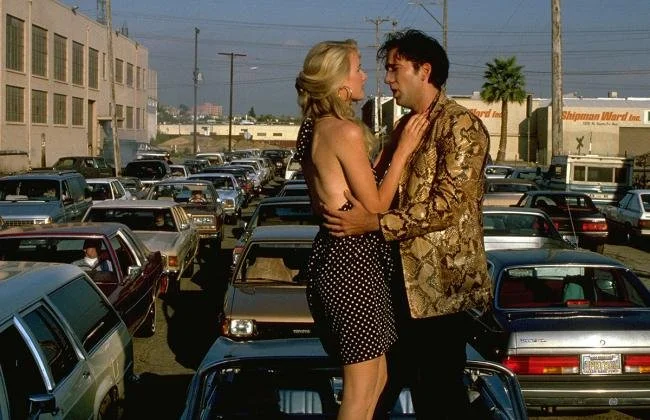
Wild At Heart features a romance that on the surface is incredibly unconventional and that could be colloquially described as “freaky.” However, Lynch paints the wild couple of Lula and Sailor with strokes of conventional romance, most notably with the choice of music in the film. In one of the most memorable sequences of the film Sailor interrupts dancing at a hard rock club to perform Elvis Presley’s Love Me to Lula. This sweet display of affection is subsequent to an act of violence committed by Sailor and the speed metal song Slaughterhouse by Powermad. During the sequence, leather clad metal heads fawn over Sailor and scream like teenage girls in the audience of the Ed Sullivan Show. In this scene Lynch melds two cultures from two different times, forcing the audience to see the ways that these can coexist and passing no judgement to either. In a featurette for the film Lynch states “In life you never what’s going to come along next…there are very tender moments and then there’s very violent moments… confusion and despair, and then suddenly you’re in love… there’s gotta be room for all of these things in a film” (Lynch). Lynch taps into this “confusion and despair” with Sailor’s “tender moment” and its juxtaposition of the lovey-dovey-rockabilly music of Elvis against the violence and darkness of a hard metal club. In the same featurette Lynch describes Wild At Heart as “a love story that barrels along a strange highway through the twisted modern world.” Despite their own twistedness, Lynch ascribes that word to the modern world and not the characters. Perhaps explaining the nostalgic attributes of Sailor and Lula’s innocent expressions of love that play against the otherwise “twisted” parts of their characters.
The next time a musical sequence like the one previously mentioned occurs is at the end of the film, when in a explosion of romance Sailor runs to Lula after abandoning her and their son, and finally sings Love Me Tender, by Elvis to her— a song he makes a vow earlier in the film to only sing to the woman he marries. By the time this sequence wraps up the film, Lula and Sailor have achieved a conventional life despite their unconventional circumstances. They are back together, Lula domesticated by the birth of their child, Sailor reformed by his time spent in prison. According to both the purity of the fifties and the hedonism of modern times there is something wrong about their lives. When Sailor momentarily abandons Lula and his son he acknowledges how unorthodox their life has become compared to their character by saying “It's what makes sense is all,” However, when Sailor runs back to lula and sings a song from the fifties to her , he accepts that there is no barrier between these things. In her article “Do The Wrong Thing: David Lynch’s Perverse Style” Sharon Willis critiques the film by saying “A familiar nostalgia for the fifties and the sixties is almost ambient, and serves to overdetermined both images and narrative” (Willis 156). Willis is right to acknowledge the pervasiveness of the aesthetics of nostalgia in the film but ignores that this “ambient” “nostalgia” is what communicates the arc of conflicting values that exist in Sailor and Lula’s romance. The use of fifties pop music while sometimes seemingly comedic or surreal is sincere to the story of the characters.
Deep within the music of the Wild at Heart is a story of how values change over time. We often see these values as conflicting and acceptance of either or as indicative of some type of moral adjudication. David Lynch, does not. Instead through his use of music he makes the case that love, like anything else in life, is complicated by the times we live in but ultimately made stronger by the fact that it persists no matter what. When Sailor is knocked out by a group of street kids and hallucinates seeing the good witch, he tells her “But I'm wild at heart.” She responds “If you truly are wild at heart, you'll fight for your dreams. Don't turn away from love, Sailor.” It is the thesis of the film that to love in this day you have no choice but to be wild at heart.